First things first:
With millions of apps available on platforms like Google Play and the Apple App Store, the mobile app ecosystem is experiencing unprecedented levels of competition. Consumers today are looking for products that are easy to use, highly customisable, and beneficial to society, not just basic utilities. Our viewpoint on app development needs to change as technology does. Developers and business owners must be innovative and apply their ideas to create apps that solve real-world issues and engage users if they want to stay ahead of the curve.
The Value of Originality and Creativity in Mobile App Development
Since it’s essential for generating novel concepts to engage users and address issues, creativity is crucial in the development of mobile apps. Conversely, innovation is the application of new concepts, ideas, or technologies to improve performance, usefulness, or user experience. Combining the two results in apps that are both practical in the present and futuristic.
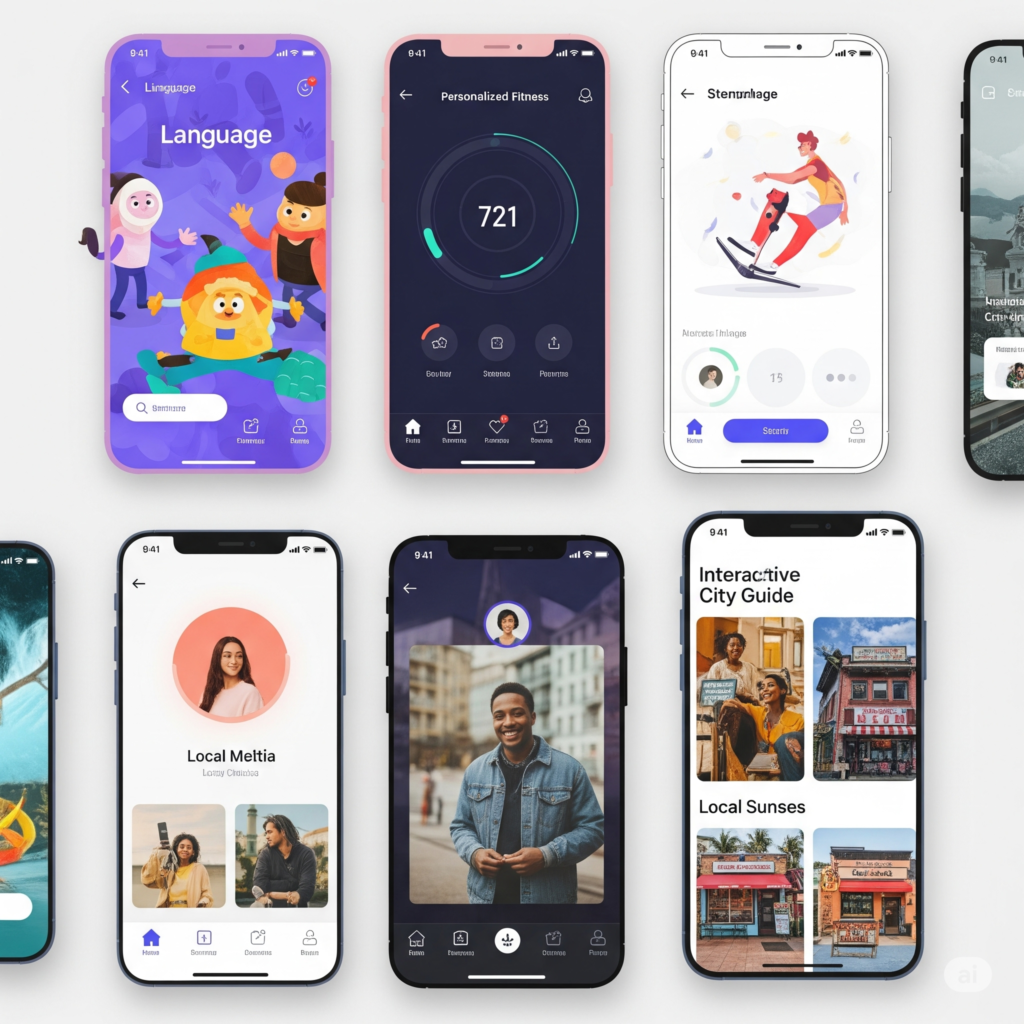
- Improved educational app that makes use of augmented reality (AR)
Imagine students studying history at home using augmented reality overlays to explore landmarks in three dimensions, or medical students performing remote operations on patients. With the aid of an augmented reality learning tool, students can participate in dynamic, experiential learning in place of static textbooks. By using ARKit or ARCore to allow students to see complex concepts, developers can increase learning efficiency and engagement.
- Customised Health and Wellness App Driven by AI
Even though activity trackers are widely used, AI-powered software that examines regular activities, food intake, stress levels, and sleep patterns may produce a highly customised wellness plan. Using biometric information, it would adjust instantly and offer recommendations in real time. The app may be combined with wearable technology, machine learning, and natural language processing to give the impression of a virtual health coach.
- Apps that encourage eco-friendly living and gamified sustainability are the third concept.
Taking personal responsibility, which gamification encourages, is one strategy to fight climate change. People could use this software to monitor their environmentally friendly behaviours, like recycling, taking the bus, or using less water. Communities can work together on badges, points, and challenges. Leaderboards and social impact metrics can be used to inspire people and motivate them to alter their behaviour.
- Blockchain-based safe platform for data exchange
Privacy and data security are two growing issues. A blockchain-based application can be used to securely and selectively share sensitive data, including IDs, contracts, and medical records, doing away with the need for centralised servers. Smart contracts guarantee that users, not outside parties, maintain complete control over their data by controlling who can access what.
- Hyperlocalized community-building program.
Large social media platforms frequently fall short when it comes to neighborhood-level engagement. In addition to bringing people together within a few miles, a hyper-local app would enable them to trade skills, organise events, share news, receive safety alerts, and participate in buy-sell-trade communities. By emphasising location intelligence, the software might help create strong micro-communities and real connections.
- Language Learning App with AI-Powered Cultural Immersion
Instead of repeating drills, this software may use AI to simulate a cultural event, like a wedding or a meal at a foreign café. Augmented reality simulations, voice interactions, and immersive video experiences could all be used to teach users. Learning becomes extremely engaging and practically useful when cultural nuances, slang, and manners are incorporated into the curriculum.
- Customised music creation and composition
A customised music app could use AI to create chord progressions, multi-genre remixes, or background music for both professional and amateur musicians. The app could create an entire composition simply by humming a melody. The creative process would be improved by incorporating virtual tools and teamwork technologies.
- Management app for a decentralised autonomous organisation (DAO).
As mobile-first DAO management solutions gain popularity in the cryptocurrency space, there is an increasing need for them. Users of this app can manage treasuries, vote, suggest ideas, and monitor on-chain governance developments. Widespread DAO participation would be made possible by a more user-friendly interface, biometric authentication, and integrated secure wallets.
- Interactive Storytelling-Based World-Building
This tool would be perfect for educators, writers, and gamers as it would allow users to work together to create fictional worlds with interactive maps, story arcs, and branching narratives. Users can work together to create interactive stories that change based on the reader’s selections thanks to a modular design. AI could lead to writing recommendations, lore consistency checks, and auto-generated content.
- Exchange skills and trade cryptocurrency
Some people still favour more conventional forms of payment, even in this era of the gig economy. This app’s token-based economy allows users to exchange services, such as web design for yoga classes. Verifiable reputation systems and smart contracts are used to guarantee transparency. Low-income rural or underprivileged areas would particularly benefit from this peer-to-peer approach.
Develop Innovative Mobile Apps
These days, mobile apps are ecosystems that promote influence, innovation, and interaction rather than just being tools. Apps that put people first, use cutting-edge technology, and are socially conscious will produce the next wave of app success stories. Those who are brave enough to envision and create applications driven by augmented reality, blockchain, or artificial intelligence will rule the future. Hire experts to build your next big mobile app.